
Nestled high on a scenic hill overlooking the Black River Valley, Thompson Park stands as one of the grandest public spaces in Northern New York — Jefferson, Lewis & St. Lawrence Counties. For generations of North Country residents, this 355-acre expanse has been a sanctuary for recreation, community gatherings, and natural beauty. But the true story of Thompson Park begins with a Gilded Age industrialist’s secret gift and the most famous landscape architecture firm in American history.
On this page
- The Great Lawn: The Park’s Front Porch
- A Visionary Gift: John C. Thompson and the Park’s Origins
- The Olmsted Brothers Legacy in Northern New York
- Evolution of the Crown Jewel: From Pavilions to the Zoo
- Modern Preservation and Community Impact
- Honor the Mountain: A Monument at Tower Square
- Frequently Asked Questions
The Great Lawn: The Park’s Front Porch
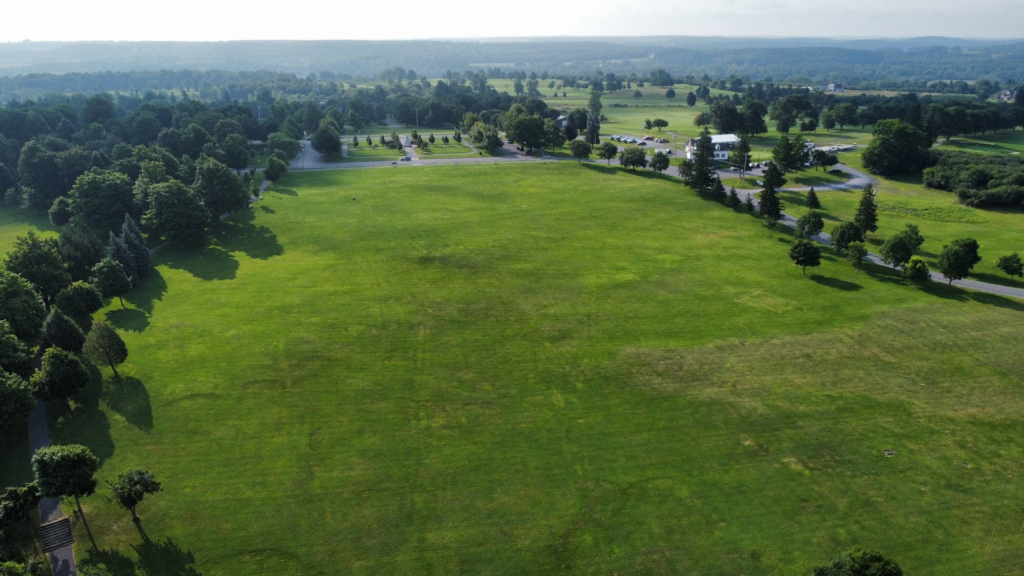
Ask a Watertown native about Thompson Park and they’ll probably point you to the great lawn first. This wide-open green expanse overlooking the city has been the park’s unofficial town square for decades — a favorite spot for picnics, pickup games, and summer concerts, and a popular launch point for model-plane flyers. When the park hosts community events, this is usually where they happen, with the whole valley spread out as the backdrop.
A Visionary Gift: John C. Thompson and the Park’s Origins
In the early 1900s, John C. Thompson — a prominent businessman with the New York Air Brake Company — set out to give Watertown something extraordinary. His plan was carried out in secret: the land was offered to the city as an anonymous Christmas gift in 1916, with the donor’s identity kept from the public. The deed transfer was completed in 1921.
Thompson’s initial gift of 191 acres was just the beginning. Over the following years, the city purchased additional surrounding land, growing the park to the 355 acres it covers today in the southeast corner of Watertown.
What makes this gift remarkable is that Thompson didn’t just donate raw land — he had the foresight to hire world-class designers to shape it before handing it over.
The Olmsted Brothers Legacy in Northern New York
The park’s breathtaking layout is no accident. It is the work of the Olmsted Brothers landscape architecture firm — the successors of Frederick Law Olmsted, the designer of New York City’s Central Park.
Thompson commissioned the firm in 1899 to transform a rugged tract on the Tug Hill Plateau known locally as “The Pinnacle.” On the original architectural drawings, the project was simply called “Watertown Park.” John Charles Olmsted took personal charge of the design, visiting the site in the summer of 1899 and producing an ambitious 500-acre plan — far larger than the park’s eventual footprint.
True to the Olmsted philosophy, the design didn’t try to conquer the terrain. Winding carriage roads, walking trails, and scenic overlooks were threaded through the natural topography to frame the sweeping views of western Jefferson County and the distant Lake Ontario shoreline. Heavy native fieldstone and quarry stonework went into the park’s pavilions, stairways, and overlooks, so the structures feel like natural extensions of the rocky plateau.
Evolution of the Crown Jewel: From Pavilions to the Zoo
As the park grew through the 20th century, so did its attractions. One of the most charming chapters in its history began in 1920, when the Northern New York Trust Company donated two white-tailed deer to the park. That modest gift took root and eventually grew into what is now Zoo New York at Thompson Park — the only zoo in the North Country dedicated entirely to animals native to New York State.
The park’s golf course, additional pavilions, and the distinctive playground areas followed over the decades, making Thompson Park as much a community gathering place as a scenic one.
Modern Preservation and Community Impact
Maintaining a century-old landscape takes dedication. Today the park is managed by the City of Watertown’s Parks and Recreation Department, and since 2015 an advocacy group, the Friends of Thompson Park, has worked alongside the city with the endorsement of the Watertown City Council to support its upkeep.
Recent years have brought careful updates that respect the original Olmsted design: a new park playground was completed in 2017, and the park remains open to the public daily from 7 a.m. to 9 p.m., year-round.
Honor the Mountain: A Monument at Tower Square
The park’s summit, known as Tower Square, received its most meaningful modern addition on July 1, 2016, when the Honor the Mountain Monument was unveiled during Watertown’s Independence Day festivities.
Designed by sculptor Susan Grant Raymond, the monument is a pointed granite structure roughly nine feet tall, with bronze reliefs tracing the timeline of the 10th Mountain Division — from its World War II origins training at Camp Hale, Colorado, through its 1985 reactivation at Fort Drum, to its post-2001 deployments. A fourth side was deliberately left blank to hold a time capsule marking the division’s future 50th anniversary.
The monument stands as a permanent expression of gratitude between the city of Watertown and its neighboring military community — soldiers of the 10th Mountain Division, their families, and the civilian workforce at Fort Drum. For newcomers arriving at Fort Drum, it’s worth the drive up the hill: the view alone explains why locals call this the crown jewel. (If you’re new to the area, start with our Fort Drum newcomer hub.)
In June 2025, the community gathered at the park once more — during the U.S. Army’s 250th birthday celebration — to rededicate the monument.
Frequently Asked Questions
Who designed Thompson Park in Watertown, NY?
The park was designed by the Olmsted Brothers firm — successors of Frederick Law Olmsted — with John Charles Olmsted personally leading the 1899 design.
When was Thompson Park established?
John C. Thompson gave the land to the city as an anonymous Christmas gift in 1916, with the deed transfer completed in 1921. The Olmsted design dates to 1899, when the project was called “Watertown Park.”
Is Thompson Park open year-round?
Yes. The park is open daily from 7 a.m. to 9 p.m., year-round.