
When Dustin Baker and his family run into old friends, the question always comes up: is Dustin still competing? Still training? Twenty years after the Golden Gloves win that started it all, here’s a look back at that career — a blast from the past, told mostly in his own words.
The short answer is no: he hasn’t competed in a decade, and he’s at peace with that. The longer answer is this story.
Dustin Baker’s formal boxing training began in November 2005 in the attic of the Teen Center on High Street in Watertown, because Watertown did not have an established boxing gym at the time. Five months later, at 19, he won the New York State Golden Gloves heavyweight championship in Syracuse. He went on to win state and national-level grappling titles over the next decade, turn professional in mixed martial arts, and — without ever really planning it — help bring a boxing club back to his hometown.
An attic, then a basement
Baker had loved boxing since he was a small child — the Rocky movies at home, and his great-grandfather’s old gloves, found in his grandmother’s attic, that he and his cousin would pull on. But formal training waited until he was 18. The Teen Center attic was not a traditional boxing facility, but it was somewhere to work and learn. For the final couple of months before the Golden Gloves, the group — John Pepe, Chuck Berkman, and Kevin Oliver among them — moved training into Berkman’s basement in an apartment building.
“I literally started in an attic,” Baker says, “and finished preparing for the Golden Gloves in a basement.”
Pepe, Berkman, and Oliver had long talked about Ray Rinaldi’s gym in Syracuse — its history, its fighters, the experience of its coaches — and about once a week they took Baker down to spar. He was nervous on those trips, every time; his stomach would be in knots on the way. The early trips went well. Then, a few weeks before the tournament, he was matched for the first time with a fighter named Bruce, an accomplished amateur the coaches had kept him away from — a multiple-time open-division Golden Gloves champion who later turned professional. Baker landed three or four clean, well-timed straight right hands, busted Bruce up, and Bruce ended the session. The coaches told him that if he could do that against a fighter with Bruce’s experience, he had a very good chance of winning the novice Golden Gloves.
The 2006 Golden Gloves
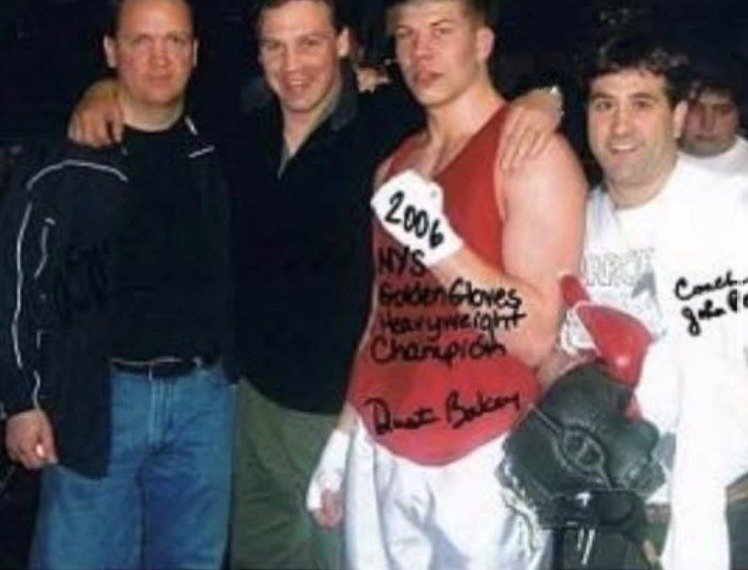
The tournament was covered by the Watertown newspaper, and family, friends, and people from home he barely knew came to Syracuse to watch. Baker grew calmer as the tournament went on. In the championship final, on April 8, 2006, his straight right — always one of his best punches — did the decisive work in the second round: he caught his opponent with a couple of good ones and broke his nose with one of them, winning the final by knockout. The Watertown Area Boxing Club’s records list him as the 2006 Sub-Novice Heavyweight champion, at 200 pounds.
Watch the full championship bout.
“The best way I can describe it,” he says of winning, “is that I felt like I had a new life ahead of me.” Even with everything he later accomplished in grappling, he says winning the Golden Gloves “remains my most meaningful championship.”
The win that brought boxing back
When Baker started, Watertown hadn’t had an established boxing gym in years. After his championship, the newspaper coverage generated fresh interest in the sport locally. That summer, Tom Horning stepped forward and donated space for a gym — and the Watertown Area Boxing Club was established in 2006. It has operated ever since, with John Pepe, Baker says, deserving tremendous credit for keeping it going and helping it grow.
Baker says he is “extremely proud” that his Golden Gloves championship played a part in bringing a boxing club back to Watertown — that knowing it helped create opportunities for other young people in his hometown means a great deal to him.
Learning a whole new fight
Baker didn’t turn toward grappling and MMA because he had stopped loving boxing. He wanted to be a complete martial artist — to understand wrestling, takedowns, ground fighting, and submissions, not just the stand-up game. He had become a fan of the early UFC and The Ultimate Fighter, and his best friend, John Deegan, had moved to Tampa specifically to train in Brazilian jiu-jitsu and MMA at Gracie Tampa, under Rob Kahn. The two talked constantly — Deegan reporting on jiu-jitsu, Baker on his Golden Gloves preparation.
After winning the title in April 2006, Baker worked through the summer, saved his money, and in October 2006 went to Tampa to stay with Deegan and train. He stayed six to eight weeks, and it was an eye-opener. He arrived a Golden Gloves champion — strong, athletic, confident — and found himself wrapped up, controlled, and submitted on the mats by training partners who were smaller and less athletic than he was, but who had technical knowledge he didn’t. That, he says, is exactly what hooked him: the demonstration that technique, leverage, and timing could beat size and strength made him want to learn the art properly.
First tournaments — and the titles start
Back in Watertown, life intervened: his daughter, Savannah, was born in 2008. Toward the end of that year he started training at the Watertown judo club with Jordan Damon, who ran no-gi grappling sessions geared toward MMA alongside judo, takedowns, and striking. In 2009, Marc Stevens opened Jiu-Jitsu Nation on Arsenal Street, and much of the judo club group trained there as well. Baker learned a great deal from both men — Damon, a high-level black belt he calls a natural at the sport, and Stevens, a Division I wrestler and professional fighter whose work ethic he respected even though the two never quite clicked personally. Stevens, for his part, told Baker he was “the most talented guy he had ever seen.”
Baker’s first grappling tournament was the NAGA World Championships in Newark, New Jersey, on April 4, 2009. He won his first two matches before losing a close match on points. Two weeks later, on April 18, he won the New York State Grappling Championship in Fredonia — in only the second tournament he had ever entered.
Watch his Newark matches: Fight 1 · Fight 2.
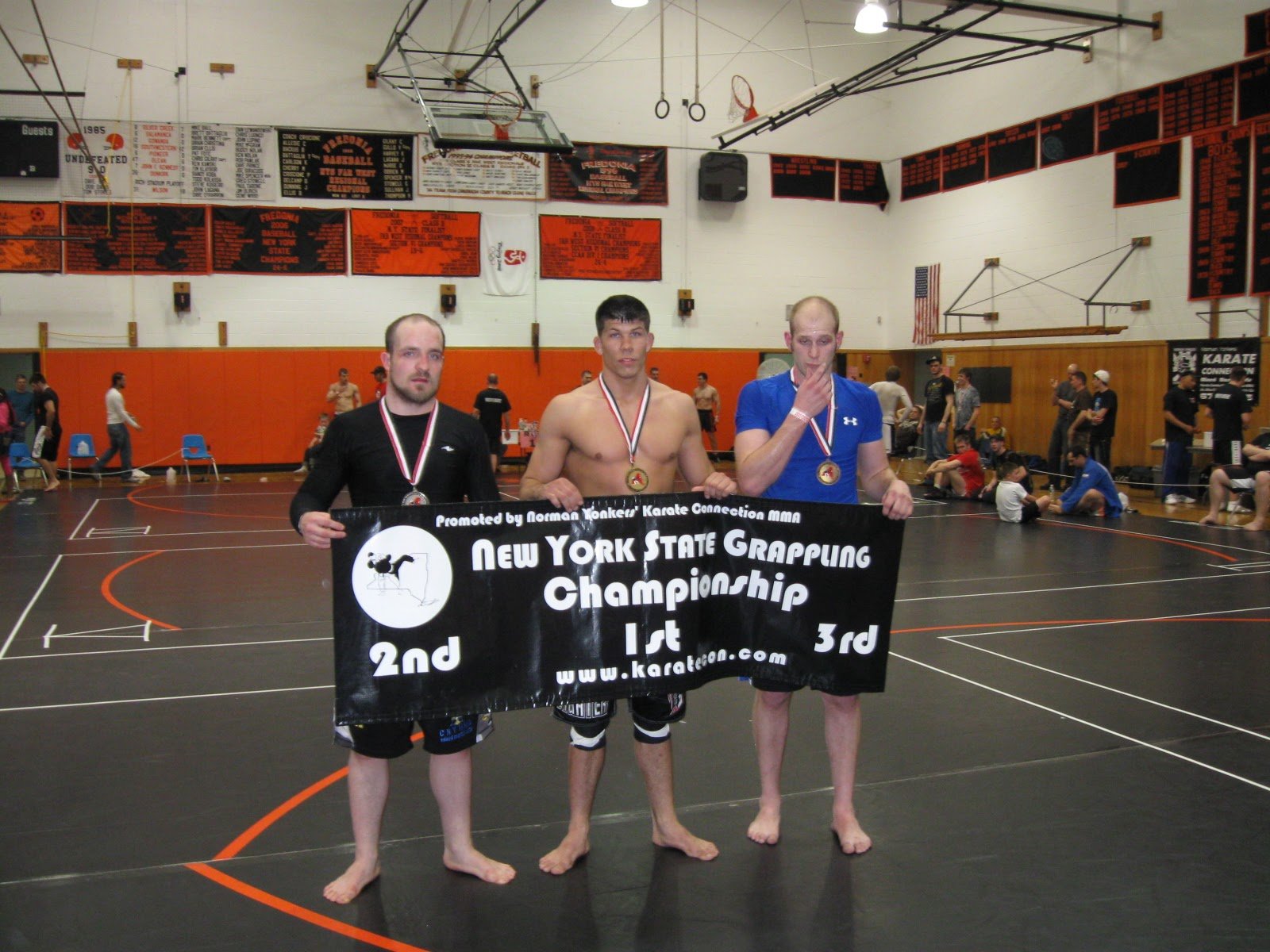
He won the state championship again in 2010 — on April 24 in Fredonia, winning every match by submission — the only two years he entered it. That May he added a NAGA East Coast gold medal, winning the championship match by choke in Springfield, Massachusetts. By 2010, he says, his movement, timing, and confidence had come together: he could relax, read what was happening, and flow rather than think through every movement.
Watch the 2010 run: state championship matches · state final · NAGA East Coast final.
Grappling wasn’t the only direction his training was pulling him. Out of Jiu-Jitsu Nation, Baker had also begun testing himself in amateur MMA competition — and on March 20, 2010, in Erie, Pennsylvania, he stopped Troy Musil by TKO in the first round.
Three golds in a day, and the Boston belt
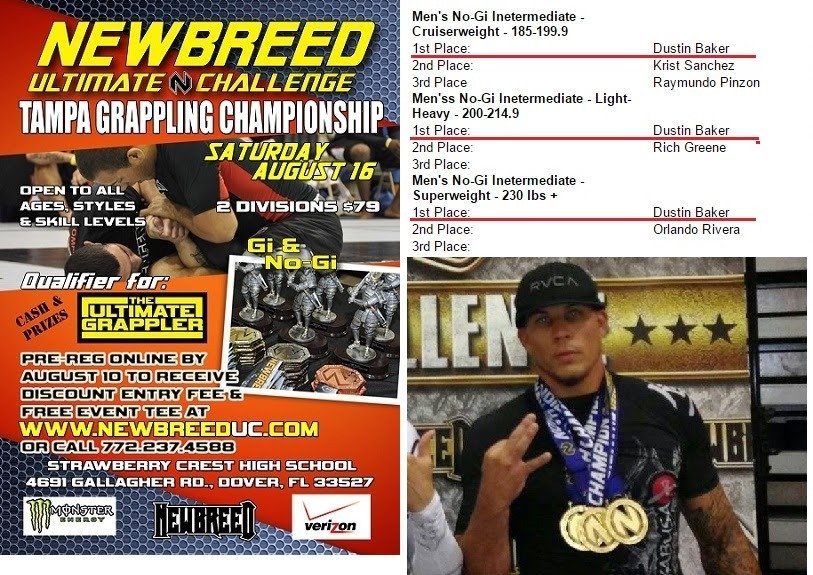
One of his favorite accomplishments came at a NewBreed tournament in Tampa in 2014. He hadn’t competed in three or four years, but he had kept training and arrived, he believes, at his absolute physical peak. He won his own weight division; asked to move up a class, he won that one too; moved up once more, and won a third. Three divisions, three gold medals, in a single day — at an event where almost nobody knew who the Watertown fighter was. By his last match, he says, a crowd had gathered, and he could hear people asking who he was.
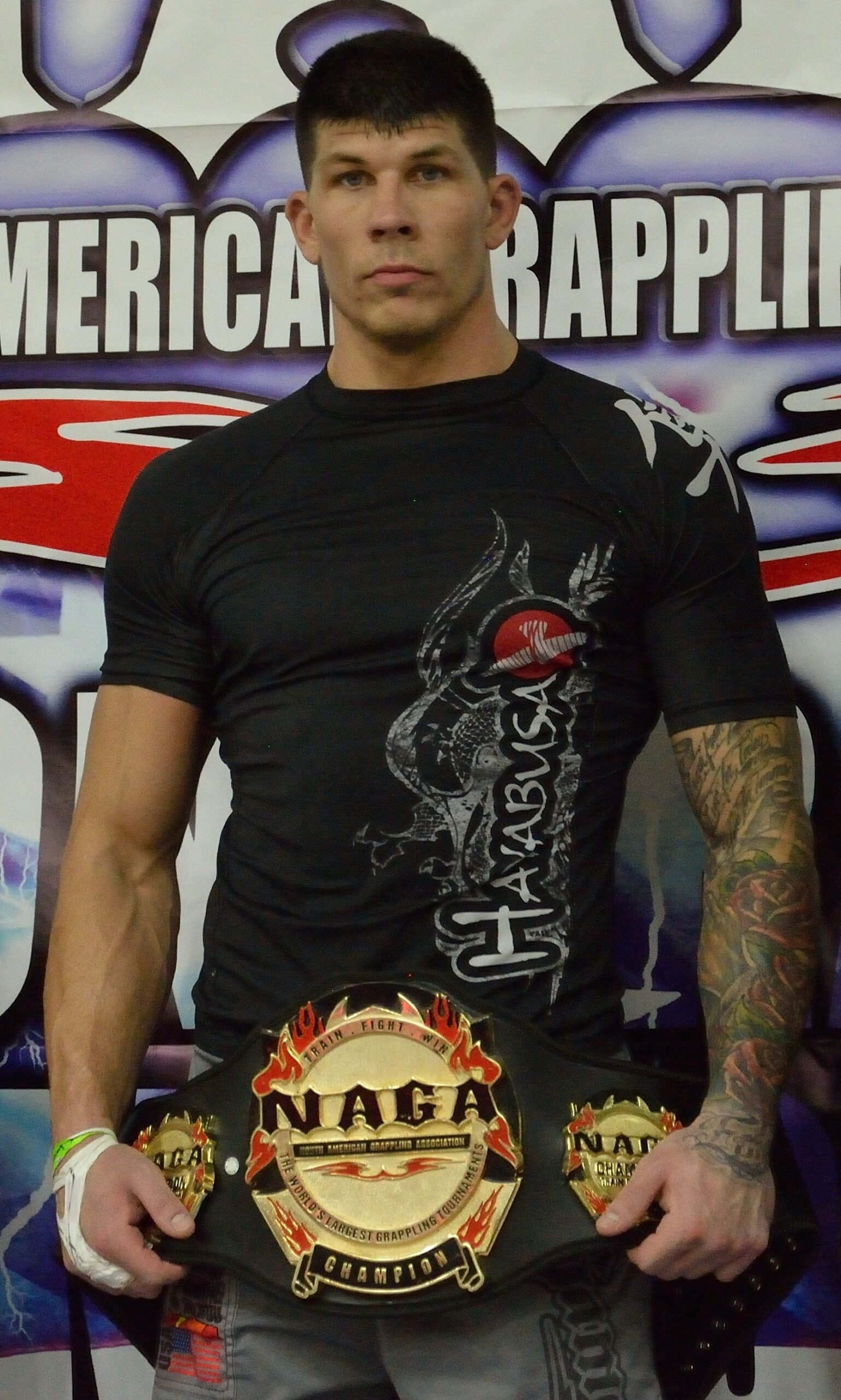
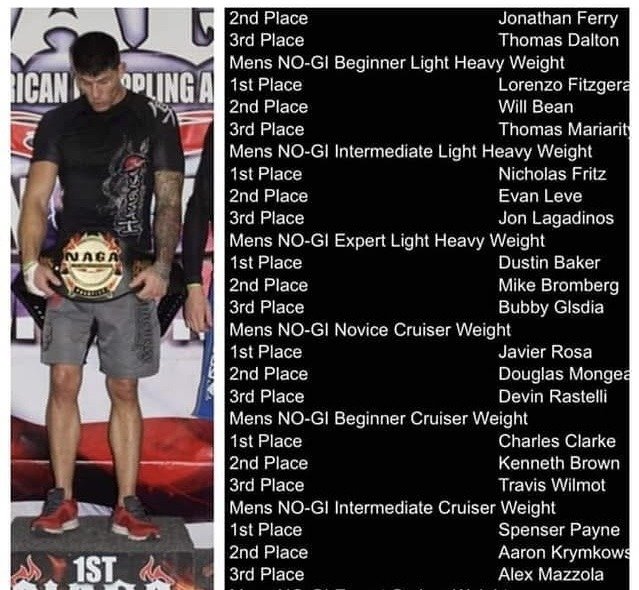
His final grappling tournament was the NAGA championship in Boston in 2016, where he won the men’s no-gi expert light heavyweight division. He had wanted a NAGA expert title for years, working his way up through the experience levels, and, he says, “winning at the expert level felt like the completion of that progression.” Outside of the Golden Gloves, he counts it as the grappling title that means the most to him. It was his last tournament.
The professional chapter
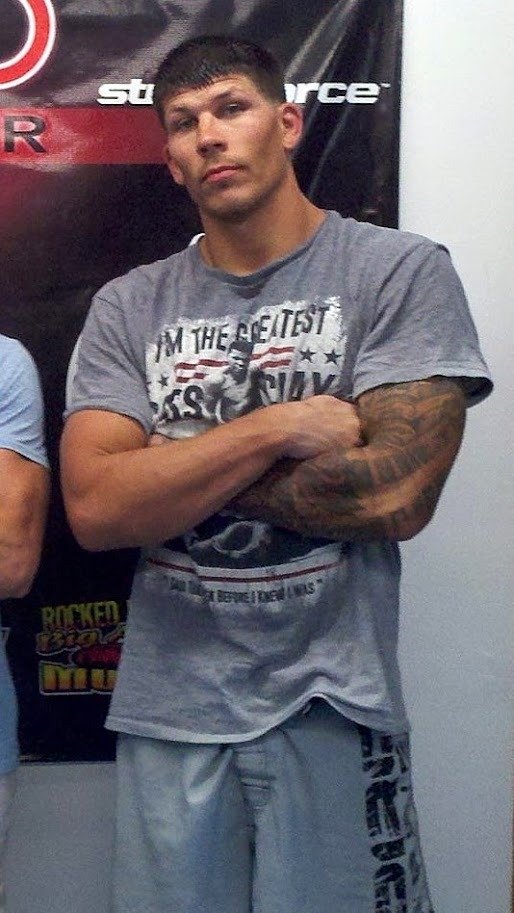
Becoming a professional fighter, Baker says, was never necessarily his ultimate goal — he loved competing and believed he could do it well with the right environment around him, but Watertown then had neither the established MMA coaching infrastructure nor the connections to major organizations that bigger training centers offered. Still, after training partners like Stevens and Damon began winning professional fights, and holding his own with them in training, he took the opportunity.
His professional debut came in Philadelphia, in the main event, on September 25, 2010 — and he won it in the first round, submitting Joshua Key with a triangle choke at 1:17. His second fight, against Jeff Nader, he says he regrets taking: accepted on about a week’s notice, up a weight class, after time away from training. Underprepared, he was stopped with a broken nose. The lesson he took from it was plain — professional MMA is dangerous, and if he was going to continue, it had to be with proper preparation, serious coaches, and high-level training partners.
In January 2011 he went to St. Louis and trained for five months at the Hit Squad, under coach Marc Fiore, alongside former UFC champion Matt Hughes and other top professionals. Fiore quickly took to him — he was submitting some of the gym’s best grapplers and getting the better of top fighters in sparring — and when an opening came up against undefeated local prospect Lance Benoist, Baker walked into Fiore’s office and asked for the fight himself. In the fight, he dropped Benoist with a hard straight right and followed him to the ground — and was caught in the triangle choke Benoist secured despite being hurt. He lost a fight he had been winning, against a man who later fought in the UFC, and Fiore’s confidence in his future, he says, never wavered afterward.
That same era included hard sparring, back in 2009, with a young Jon Jones at Tai Kai Jiu-Jitsu in Liverpool, outside Syracuse — Jones, of course, went on to become one of the greatest fighters in UFC history.
The Hit Squad changed hands in 2011, Fiore left, and Baker came home. That fall, Fiore opened his own gym in Springfield, Illinois, and in November 2011 Baker traveled there to train with him again — family, friends, and people in the Watertown community had helped raise money so he could pursue the opportunity, support he says he still appreciates deeply.
Springfield, though, wasn’t St. Louis. What Fiore had there was a brand-new operation — essentially a room where he was trying to get a training program started — not the established professional fight team Baker had known at the Hit Squad, and Fiore himself was in the early stages of building it rather than running the kind of structured program Baker had trained under. The living situation worked against him, too: he was sharing a hotel room with two other people, a family member and a friend, neither of them fighters, who were going out, drinking, and staying up late — not the disciplined environment a professional athlete needs. After about two months he came home, disappointed: he had gone there to develop as a professional, with a lot of people back home behind him, and the circumstances simply weren’t right for what he was trying to accomplish.
That experience fed directly into what came next. Feeling an obligation to the people who had believed in and invested in him, he accepted one more professional fight without the preparation it required — no real MMA sparring, no structured striking work — after a difficult weight cut, and lost by submission, exhausted early. He regrets his second and fourth professional fights, he says, because he wasn’t properly prepared for either; he believes the lack of a complete professional training environment in Watertown was a major factor, and he is careful to add that he appreciates everyone who trained with and helped him.
After that last fight, he says, he felt relieved to be finished for a while. He focused on work and family: Savannah had moved to Florida in 2011, he began traveling there to spend time with her in 2012, and in 2013 he moved to Florida to be closer to her, returning to Watertown at the end of 2014. “I never officially announced my retirement,” he says, “but I moved on with my life.” Thoughts of one more fight, when they came later, were a competitor wanting a better ending — not a wish to build the career again.
Today
Baker moved back to Sarasota, Florida, in January 2025, and works in management. He no longer trains in boxing, jiu-jitsu, or MMA — at this stage of his life, he says, the risk of injury isn’t worth it; he has to be able to work and take care of his responsibilities. He stays active with occasional trips to a regular fitness center and tries to live healthy, even if he’s no longer training like an athlete preparing for competition.
Between about 2022 and 2024, while living in Watertown, he would stop back into the boxing club for a few weeks at a time — work out a little, help some of the younger fighters, do some light sparring. Even years removed from serious training, he says, he still felt sharp moving around in the ring. He has no plans to return to competitive boxing or MMA.
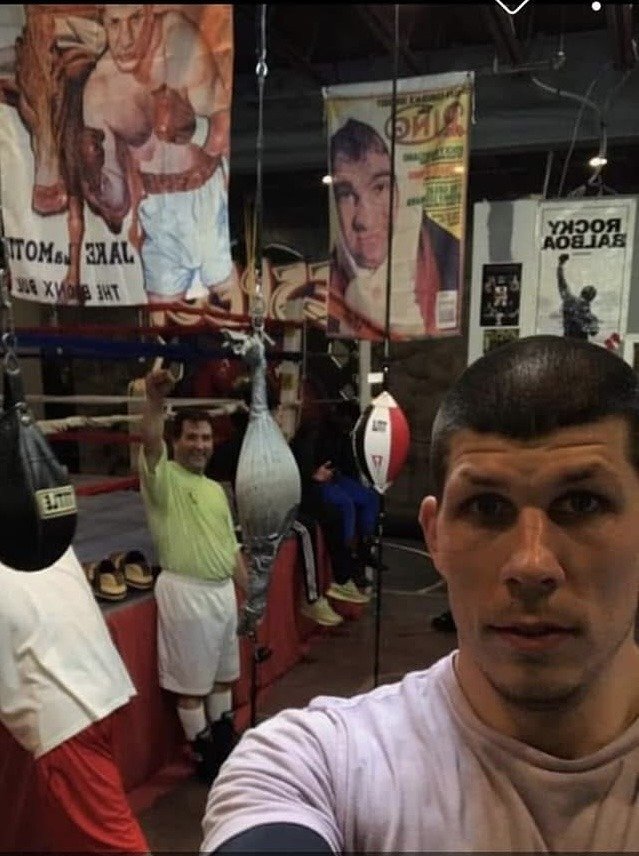
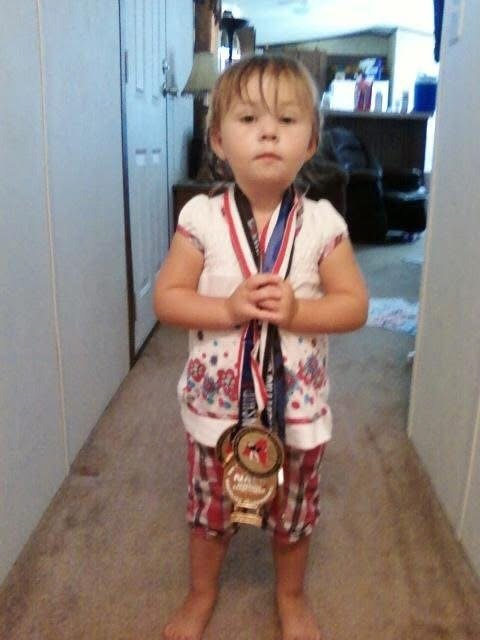
Looking back, Baker says he is proud of what he accomplished, and of the experiences the sports gave him — the people he trained with, the places he competed, the championships. There are things he would do differently, particularly around his professional fights. But the shape of the story is his own summary: a kid who found his great-grandfather’s gloves in an attic, started formal training in another attic a few streets from home — and, within five months, held a Golden Gloves championship that helped bring boxing back to Watertown.
Dustin Baker’s titles
- 2006 — New York State Golden Gloves champion, Sub-Novice Heavyweight (200 lbs), Syracuse; final won by knockout
- 2009 & 2010 — New York State Grappling Champion (the only two years he entered)
- 2010 — NAGA East Coast grappling gold medalist
- 2014 — NewBreed Tampa: first place in three no-gi divisions in one tournament
- 2016 — NAGA Boston: men’s no-gi expert light heavyweight champion (final tournament)
- Professional MMA — won his professional debut (first-round triangle choke, Philadelphia)