
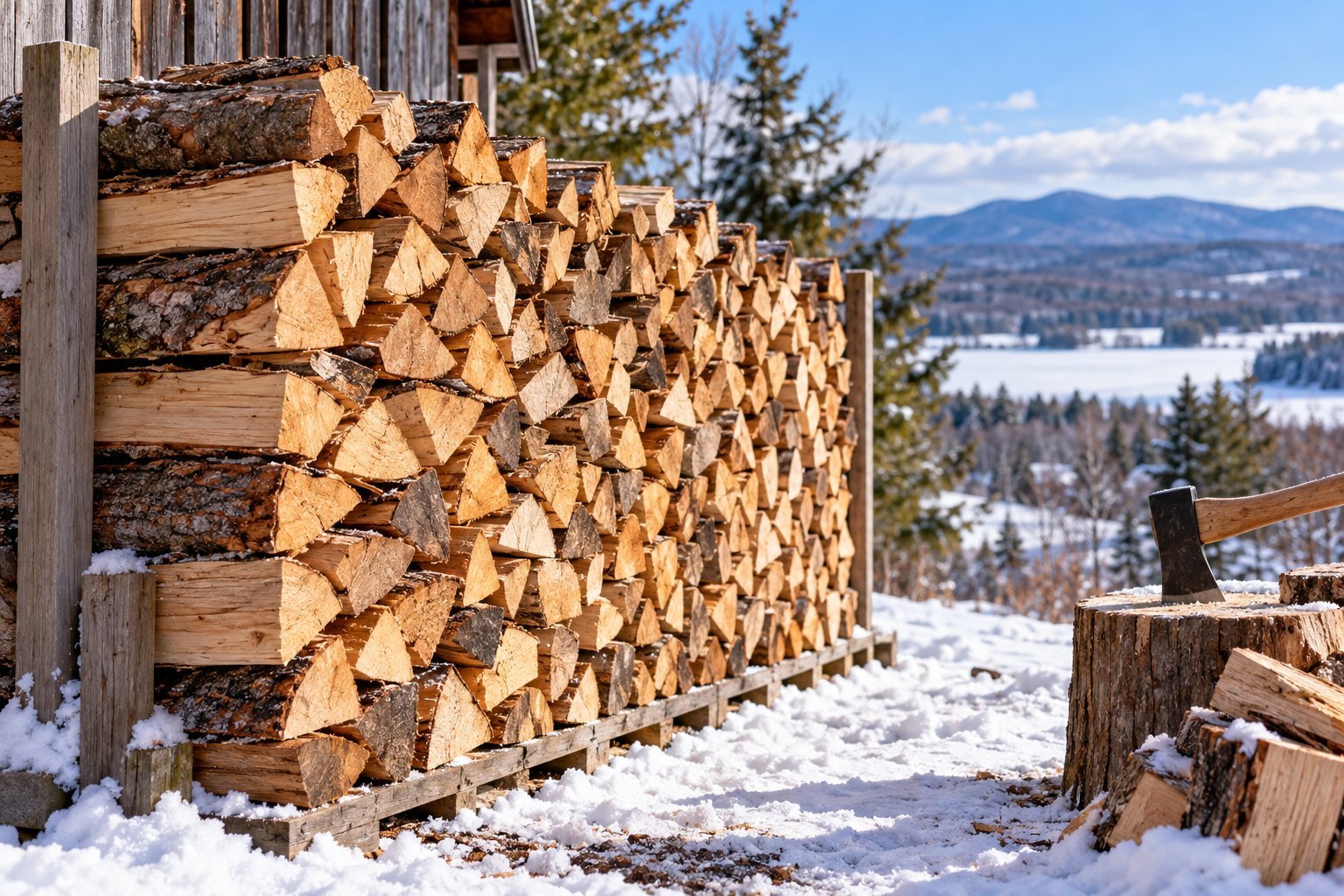
Buying firewood sounds simple until the truck leaves and you stack what’s actually there. A “cord” that turns out to be two-thirds of one, “seasoned” wood that hisses and steams until Christmas, a load of “hardwood” that’s mostly poplar — these are the classic disappointments, and in Northern New York they’re avoidable, because New York law is unusually specific about how firewood may be described and sold. This guide walks through what the words on a firewood ad legally mean, how to check a delivery with a tape measure, which species give you the most heat for the money, and the state transport rule that says how far a load of wood may legally travel — including to your camp.
On this page:
- How much wood is in a cord?
- Seasoned vs. green: what “seasoned” has to mean
- Which wood heats best
- The 50-mile rule: how far firewood may travel
- Buying and delivery: questions to ask before the truck is loaded
- Storing your wood
- FAQ
- Sources
How much wood is in a cord?
A cord is a measure of volume, not a truck size, a pile size, or a feeling. Under New York’s firewood regulation (1 NYCRR §221.13), a cord is 128 cubic feet of wood, ranked and well stowed — the standard stack is 4 feet high × 8 feet long × 4 feet deep. The same rule requires that the dimensions “shall be stated whenever the term is used”: a seller advertising cords in New York owes you all three measurements, not just the word.
The units that cause the trouble are the smaller ones:
- Face cord. A stack 4 feet high × 8 feet long, but only one piece-length deep. Its volume depends entirely on the cut length: pieces cut to 16 inches make a face cord of about 43 cubic feet — one-third of a cord. At 24 inches it’s half a cord; at 12 inches, a quarter. New York requires a face cord’s dimensions to be stated too — which means a “face cord” price quoted without a piece length is a price for an unknown amount of wood, and cannot be compared with anyone else’s.
- “Truckload,” “rack,” “rick,” “pile.” None of these is a legal measure in New York. They may describe a fair amount of wood or a skimpy one; there’s no way to know until it’s stacked and measured.
The stack-and-measure test. When a delivery arrives, stack it (or have it stacked) in a straight, tight row and measure: length × height × depth, in inches, divided by 1,728 gives cubic feet; divide by 128 and you have cords. A true cord of 16-inch wood stacks out to three rows of 4 × 8 feet. If the math comes up well short, you have something concrete to point to — and because New York law defines the terms, a short load isn’t just a disappointment, it’s a mislabeled sale. Keep the receipt or label that came with the wood; you’ll want it for the 50-mile rule below as well.
Seasoned vs. green: what “seasoned” has to mean
Wood burns well when it’s dry — as a rule of thumb, at or below about 20% moisture. Green (fresh-cut) wood can be a third to half water by weight: it lights hard, hisses, makes more smoke and creosote, and gives up a share of its heat just boiling off its own water. “Seasoned” is the word sellers use for wood that has been dried — and in New York it’s not allowed to be a shrug. Under the same §221.13, if firewood is represented as seasoned, the length and manner of seasoning must be specified. “Seasoned” with no how-long and no how-stored behind it is an incomplete claim, and asking the follow-up is your right as a buyer: Seasoned how long, and how? Split and stacked in the open air for a year is a very different answer from “cut last spring and left in a pile.”
Practical checks when the wood arrives: seasoned pieces feel lighter than green ones of the same size and species, the ends often show small cracks (checking), and two pieces knocked together ring more than they thud. An inexpensive moisture meter, pushed into a freshly split face, settles the argument in seconds.
One timing note North Country buyers learn the hard way: wood bought “seasoned” in October from a seller who cut it in September is next year’s wood whatever the ad said. The cheapest heat in this region is bought green in spring, stacked all summer, and burned the following winter.
Which wood heats best
Per cord, heat output tracks density: the heavier the dry wood, the more heat in the stack. Approximate heat content for the species sold around the tri-county area, in million BTU per air-dried cord (published tables vary a few percent by source and moisture — the ranking is the point):
| Species | Approx. million BTU per cord |
|---|---|
| White oak | 25.7 |
| Sugar (hard) maple | 24.0 |
| American beech | 24.0 |
| Red oak | 24.0 |
| White ash | 23.6 |
| Yellow birch | 23.6 |
| Paper birch | 20.3 |
| Black cherry | 20.0 |
| American elm | 19.5 |
| Red (soft) maple | 18.4 |
| Aspen | 14.7 |
| Eastern white pine | 14.3 |
| Basswood | 13.7 |
Read the table as money: a cord of hard maple carries roughly two-thirds more heat than a cord of aspen or pine at the same stack size. That doesn’t make the light woods useless — they’re fine for kindling, spring and fall shoulder-season fires, and campfires — but a “cord is a cord” price comparison across species is not a comparison at all.
New York law helps here too, if you read ads closely: “hardwood” may not be used for conifers (pine, spruce, fir, hemlock), aspen, poplar, basswood, butternut, willow, or grey and paper birch (§221.13). So a load advertised as “hardwood” that shows up full of poplar or paper birch isn’t just disappointing — it’s mislabeled. Note the birch distinction: yellow birch is a genuine high-heat hardwood; paper birch, the white-barked one, legally is not, whatever the ad implies. Mixed loads are fine and common — just know the mix before the price is set, because the mix is most of what the price should reflect.
The 50-mile rule: how far firewood may travel
Separate from how wood is sold, New York regulates how far it may move — the NYSDEC firewood rule, aimed at the invasive insects and diseases (emerald ash borer, Asian longhorned beetle, oak wilt) that hitchhike in firewood:
- Untreated firewood grown in New York may not be transported more than 50 miles (straight-line distance) from its source or origin — origin meaning where the wood was grown.
- Untreated firewood may not be brought into New York from another state or country at all.
- Anyone transporting firewood must carry documentation: a receipt or label identifying the source for purchased wood, or a Self-Issued Certificate of Origin (a free DEC form) for wood you cut yourself.
- Sellers of untreated firewood must obtain wood grown within 50 miles of their business, and may then declare the business as the source — so the source on your receipt may be the seller’s address, and your 50 miles runs from there.
- The exception: firewood heat-treated to the state standard — a core temperature of 160°F held for 75 minutes — and labeled “New York-Approved Heat Treated/Pest Free” may be moved without restriction. Note that “kiln-dried” alone is not the same claim: kiln-drying describes drying the wood, and not every kiln run reaches the treatment standard. Look for the approved label.
- Never burn pressure-treated wood, whatever its source.
What this means at the kitchen table: a bargain cord advertised two counties away isn’t a bargain you can legally haul home, and the load of wood from your own lot that you take to camp — including camps well inside the region, if they’re more than 50 straight-line miles from where the tree grew — falls under the same rule, certificate and all. DEC’s firewood page (linked under Sources) carries the full regulation, the certificate form, and source-area maps for checking the distance; when in doubt, buy wood near where you’ll burn it, keep the receipt in the glove box, and the question never comes up.
Buying and delivery: questions to ask before the truck is loaded
You don’t need a contract for firewood — but five minutes of questions before you order prevents nearly every bad delivery:
- “Is that a full cord — 4 by 8 by 4?” If it’s a face cord, ask the piece length, and do the fraction (16 inches = one-third cord) before comparing prices. Compare every offer as a price per full-cord equivalent; it’s the only honest common denominator.
- “What species, and what’s the mix?” A stated mix lets you use the heat table above. “All hardwood” is a legal claim in New York, not a compliment.
- “Seasoned how long, and how?” The law requires the specifics; a good seller answers without blinking.
- “Is delivery included, and is stacking?” Dumped in the driveway and stacked in the shed are different products at different prices. Know which one you bought — and remember that a dumped load can’t be measured until you stack it.
- “Where’s the wood from?” The answer determines whether you may legally take it anywhere else — and the receipt or label that comes with it is your documentation under the 50-mile rule.
- “What’s the piece length?” Sixteen inches fits most stoves; if your firebox wants 18 or 20, say so before it’s cut, not after it’s stacked.
Paying on delivery, after the wood is on the ground and you’ve seen it, is the normal arrangement with most local sellers — and stacking it the same day (or asking the seller to) is what turns “about a cord” into a measurement nobody has to argue about.
If you’re also deciding between plowing your driveway yourself and hiring it out this winter, our companion guide — Snow Plowing in Northern New York — walks through the same kind of math for the other half of the season. And the Winter Survival Guide covers the rest of cold-weather readiness in one place.
Storing your wood
Dry wood doesn’t stay dry by accident. Stack it off the ground (pallets, rails, or a rack), bark side up where you can, with the top covered and the sides open — a tarp over the whole pile traps the moisture you’re trying to lose. Leave air space between rows, and stack against a sunny, wind-exposed side of a shed or fence rather than in a damp hollow. Keep the main pile a few feet from the house wall — firewood shelters the insects and mice you’d rather not invite in — and bring a few days’ supply at a time to a porch or garage rack instead. Wood stored this way keeps improving all winter; wood left in a heap on bare ground starts going backward the first wet week.
FAQ
Is a face cord the same as a cord?
No. A cord is 128 cubic feet — a stack 4 × 8 × 4 feet. A face cord is the same 4 × 8 face but only one piece-length deep: at 16-inch pieces it’s about a third of a cord, at 24 inches about half. Always ask the piece length before comparing a face-cord price with anyone else’s.
Can a seller in New York just call a load “a cord”?
New York’s firewood rule (1 NYCRR §221.13) requires the dimensions to be stated whenever the term “cord” is used, and the same for “face cord.” If an ad gives no dimensions, ask for them — a legitimate seller states them as a matter of course.
What does “seasoned” have to mean?
In New York, if wood is sold as seasoned, the length and manner of seasoning must be specified. As a practical matter, seasoned means dried to roughly 20% moisture or less — split, stacked, and air-dried for months, not weeks.
Can I take firewood to my camp?
Only within the law’s limits: untreated firewood may travel no more than 50 miles (straight-line) from where it grew, and you must carry documentation — a receipt or source label for bought wood, or DEC’s free Self-Issued Certificate of Origin for wood you cut yourself. Heat-treated wood labeled “New York-Approved Heat Treated/Pest Free” may be moved without restriction.
A seller’s price per face cord looks cheaper than another’s price per cord. Is it?
Usually not. Convert both to a per-full-cord price: a 16-inch face cord is a third of a cord, so triple its price to compare with a full-cord quote. Then compare species and seasoning the same way — a cheap cord of green aspen and a cord of seasoned hard maple are not the same product at any price.
Is paper birch a hardwood?
Botanically it’s a birch; legally in New York, no — §221.13 bars calling paper (grey/white) birch “hardwood” in firewood sales, along with aspen, poplar, basswood, butternut, willow, and the conifers. Yellow birch is a true hardwood with heat output near the top of the table.
Sources
- New York firewood measurement and labeling rule, 1 NYCRR §221.13 (cord and face cord dimensions; seasoned and hardwood claims): https://www.law.cornell.edu/regulations/new-york/1-NYCRR-221.13
- NYSDEC, Firewood and invasive species — the 50-mile transport rule, documentation, Self-Issued Certificate of Origin, heat-treatment standard, and source-area maps: https://dec.ny.gov/nature/animals-fish-plants/invasive-species/terrestrial/firewood
- NYSDEC press guidance, “DEC and State Parks Encourage Campers to Use Local Firewood While Enjoying the Outdoors” (regulation summary; kiln-dried caution): https://dec.ny.gov/news/press-releases/2021/5/dec-and-state-parks-encourage-campers-to-use-local-firewood-while-enjoying-the-outdoors
- Species heat values: published firewood BTU tables (values per air-dried cord vary slightly by source and moisture; figures here are the widely published extension-table values, labeled approximate in the text).