
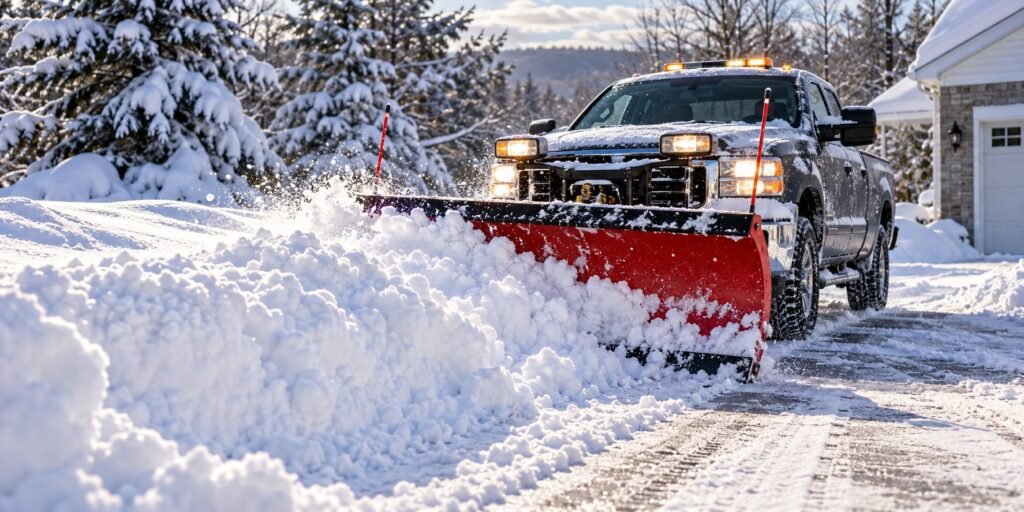
Snow plowing in Northern New York is not an occasional chore. From the first lake-effect bands off Lake Ontario in November to the last wet storm in April, keeping a driveway open in Watertown, Lowville, or Massena is a season-long job — and for many households, the first decision of winter is whether that job is theirs or somebody else’s.
This guide covers both paths honestly: how to clear your own driveway well, what it costs to hire the work out, what a fair contract should say before you sign it, and how homeowners actually find a contractor in a market that mostly runs on word of mouth. It closes with the winter parking rules that keep your car out of the plow’s way.
On this page
- How much snow are we talking about?
- Clearing your own driveway
- Hiring it done: seasonal contract vs. per-push
- What a good contract spells out
- Finding a contractor in the North Country
- Keep the car out of the plow’s way: winter parking rules
- Snow plowing FAQ
How much snow are we talking about?
Averages hide the individual storms that actually fill a driveway, but they explain why the do-it-yourself-or-hire-it-out decision carries more weight here than in most of New York. These are NOAA’s official 1991–2020 climate normals — the 30-year averages, in inches — for the reporting stations nearest each community:
| Community | Annual | Dec | Jan | Feb |
|---|---|---|---|---|
| Watertown | 116.4 | 26.9 | 34.0 | 29.6 |
| Lowville | 127.0 | 31.9 | 35.6 | 29.6 |
| Potsdam | 75.2 | 15.8 | 16.9 | 15.6 |
| Canton | 77.3 | 19.6 | 18.9 | 17.5 |
| Massena | 75.2 | 15.8 | 16.9 | 15.6 |
Source: NOAA 1991–2020 climate normals (NOAA/NCEI). Stations: WATERTOWN (for Watertown), LOWVILLE (Lowville), CANTON 4 SE (Canton), and LAWRENCEVILLE 3 SW (Potsdam and Massena — the nearest station that reports snowfall normals; neither community’s own station reports them, which is why their rows match).
The pattern in the table is the lake. Watertown and Lowville sit in and beside the Lake Ontario lake-effect bands and average roughly 115 to 130 inches a year. Potsdam, Canton, and Massena, up in the St. Lawrence valley, sit far enough north of the bands to average close to 75. Same winter, very different workload — the DIY-versus-hire math at 127 inches is not the math at 75.
Fort Drum households: the post’s own weather stations don’t report snowfall normals, so there is no official Fort Drum row to print. Watertown’s figures, from about ten miles away, are the closest official read.
Clearing your own driveway
Match the equipment to the driveway
The right tool depends on length, surface, and where the snow can go. A short paved driveway in town is a different problem from 400 feet of gravel in the Tug Hill foothills.
- Walk-behind snow blower. The default for most village and city driveways. A two-stage machine handles deep, drifted snow and the dense pack a municipal plow leaves at the curb; single-stage models struggle with that end-of-driveway berm.
- ATV or UTV with a plow blade. Workable for mid-length driveways if you already own the machine. Traction and blade weight are the limits — deep, wet snow can push a light ATV around.
- Truck-mounted plow. Real capacity, real cost, and real wear on the truck’s front end and transmission. It makes sense for long driveways and shared private roads — and is usually more machine than a standard lot needs.
- Compact tractor with a blower or blade. Common on rural properties that already own the tractor. A rear-mounted blower is slow going but moves serious snow without building banks that narrow the drive all winter.
- A shovel. Fine — genuinely — for a short driveway and a light winter. It stops being a plan when one lake-effect event drops two feet overnight.
Whatever you run, the calculus that matters is time: how long one clearing takes, multiplied by every storm from November to April. Equipment that saves twenty minutes a storm saves days over a season.
Technique that saves work later
- Clear with the storm, not after it. Two passes at six inches are easier on you and your machine than one pass at twelve, and far easier than driving over snow and packing it into ice you will fight until spring.
- Push banks back early. The first storm’s banks set your driveway’s width for the winter. Snow placed too close in November is a frozen wall by January, and every later storm has less room to go.
- Plan where the snow goes before the first storm. Pick stacking areas that won’t block sight lines at the road, bury a mailbox or hydrant, or send spring meltwater back across the drive to refreeze.
- Expect the berm. When the town or county plow comes through, it will leave a dense ridge across the end of your freshly cleared driveway. It is not personal; it is geometry. Clear it sooner rather than later — it sets up like concrete.
The one law every do-it-yourselfer needs to know
Do not push, blow, or shovel your snow into the road — or across it. New York’s Vehicle & Traffic Law, Section 1219, makes it illegal to throw or deposit snow (the statute names it directly, alongside glass, nails, and cans) on any highway, and anything that lands there must be removed immediately. Town highways carry a similar prohibition under Highway Law § 214, and many towns and villages add rules of their own.
The law exists because snow pushed into a roadway freezes into ruts and ridges, narrows the road, and blocks sight lines exactly where people pull out. Pile your snow on your own property, on the downstream side of the drive in the direction traffic travels, so the road plow does not refill your entrance with it.
When doing it yourself stops being realistic
Be honest about the breaking points, because most people who hire a contractor mid-season do it after ignoring one of these too long:
- Length and exposure. Long, open driveways in the lake-effect bands east and southeast of Lake Ontario — Adams, Lorraine, Redfield, and the Tug Hill towns — can drift shut again within hours of clearing.
- The Tug Hill factor. The plateau averages over 200 inches of snow a year. Clearing that with a walk-behind blower is not a chore; it is a second job.
- Schedule. If a storm cannot wait for you to get home from work, a contract buys reliability, not just labor.
- Health. Shoveling heavy, wet lake-effect snow is a documented heart-attack risk. If shoveling is a risk for you, that settles the question — see our Winter Survival Guide for the rest of the cold-season safety picture.
Hiring it done: seasonal contract vs. per-push
Almost every residential snow contract in Northern New York — Jefferson, Lewis & St. Lawrence Counties — is priced one of two ways.
Seasonal contract. A fixed price for the whole winter. You pay whether it snows twice a month or twice a week — which is exactly why operators offer it: a predictable revenue floor that lets them schedule routes and staff. For you, the value is a guaranteed slot on a route and no surprise bills.
Per-push (per-visit) pricing. You pay each time the truck comes. In a light winter this is usually cheaper, sometimes much cheaper. In a heavy one, the visits stack up — and the biggest risk is availability: when every driveway in the county needs clearing at once, contract customers get served first.
What it costs — read this part carefully. There are no published North Country rate sheets: operators price from the driveway, not a price list. National contractor surveys put a standard residential driveway at roughly $35–$75 per push, with long or steep drives running $100–$150, and seasonal contracts between about $300 and $1,000, most clustering between $300 and $700 (CrewNest’s 2025–26 pricing guide, Angi’s ranges). Use those numbers only to calibrate your quotes — get two or three in the fall, and compare them on trigger depth and inclusions, not just the headline figure.
The break-even math is simple: divide the seasonal quote by the per-push quote. If a seasonal contract is $500 and per-push is $50, you break even at ten visits. Fewer than that and per-push was cheaper; more, and the contract wins. The contract is also an insurance policy — it guarantees your driveway is someone’s problem on the morning the lake effect drops two feet.
What a good contract spells out
A handshake and a phone number are not a contract. Before you agree, get these in writing — or at least discussed plainly enough that nothing is a surprise in February:
- Trigger depth. Typically 2 to 3 inches: the accumulation that sends the truck. Lower means more visits and a higher price; higher leaves you driving on packed snow between visits.
- Season dates. The service window — usually November through April. Clarify what happens with an October or May storm.
- Visit caps and overage. Some seasonal contracts cap visits or push totals. Know what number triggers an extra charge and what that charge is.
- What is included. Driveway only? Walkways? The apron at the road? The berm the municipal plow leaves? Assume nothing.
- Salting and ice control. Usually extra. If it’s included, know what product and where — a salted walkway matters to households with mobility concerns.
- Staking. Whether the operator marks your driveway edges before the first snow (essential for gravel drives), and who provides the stakes.
- Damage terms. What happens to lawn edges, mailboxes, and the driveway surface itself — and who pays.
- Payment schedule. Full amount upfront is common and usually earns a discount, but monthly or per-push options exist. Get receipts.
- Insurance. Ask whether the operator carries liability insurance. A contractor without it is cheaper until something goes wrong.
- Communication. How do you reach them during a storm, and how do they notify you about timing? Routes run on rhythm; know yours.
Finding a contractor in the North Country
Here is the part most guides get wrong: there is no complete directory of snow plow contractors for Watertown, Lewis County, or Massena, because most of the market never appears in one. Much of the residential plowing here is done by one- and two-truck operators — landscapers, farmers, loggers, and moonlighting tradespeople — who fill a route each fall and advertise little or not at all. Finding one is a local-knowledge exercise, in rough order of how well each channel works:
- Ask your neighbors first. This is the single best lead, and it is not a cliché. Plow routes are geographic — an operator already clearing three driveways on your road can add yours at a better price than someone driving across the county, and a neighbor can tell you the things no listing will: whether he shows up, and how the driveway looks when he leaves.
- Watch the community Facebook groups. Each fall, operators post route openings — towns served, a few slots left — in the big North Country community and town groups, and residents ask for recommendations in the same threads. Search the group for “plowing” first; the question has usually been asked and answered.
- Check town and village groups and bulletin boards. The smaller the community, the more this still works — including the physical boards at town halls, diners, and hardware stores.
- Ask the chambers of commerce. The county chambers keep member lists, and some local operators are members. The Jefferson County hub is a good starting point for county-level resources generally.
- Ask an equipment dealer. The shop that sells and services plows in your county knows exactly who runs routes — they fix the trucks. A parts-counter conversation is a legitimate way to get two or three names.
- Search Google Maps by town. This finds the established, listed companies — worth doing, as long as you understand it shows only the visible slice of the market.
Start in September or October, not after the first storm. Routes fill from the end inward: an operator’s best slots — near his existing customers — go first, and by the first lake-effect event most good routes are closed. Mid-season openings do happen when somebody moves or quits, so it is always worth asking — but expect to pay for the scramble.
Questions worth asking any operator before you agree: Which roads near mine are already on your route? How soon after a storm do you typically reach this neighborhood? And who covers the route if your truck breaks down mid-season?
Run a plow route? If you plow residential routes in the tri-county area, email nnyinfo.com@gmail.com with the towns you serve and a contact number. No listing is promised — this is a reader-service note, not a directory — but local operators are exactly who readers ask us about, and the answers will shape future updates of this guide.
Winter parking rules
However your snow gets cleared, street parking rules decide whether municipal plows can do their half of the job — and whether your car is in your own contractor’s way. Rules are set town by town and village by village, and enforced most strictly exactly when the snow is deepest.
City of Watertown: On-street parking is allowed from May 1 through October 31. From November 1 through April 30, no parking is allowed on any city street between 2 a.m. and 6 a.m. — the hours when Department of Public Works crews are out plowing. If you rely on street parking, line up an off-street option before November: a rented spot, a neighbor’s spare space, or a municipal lot.
Everywhere else in the tri-county area: Most villages in Lewis and St. Lawrence Counties have their own overnight winter restrictions, and towns layer snow-emergency rules on top of state law — but the months, hours, and streets covered differ enough that no single summary does them justice. The reliable move is a five-minute check before the season: your village or town clerk’s office, or your municipality’s website, will have the exact rule. Do it in October, not during the first ticket-worthy storm.
One more connection: if you hire a contractor, a car parked at the curb in front of your house can block the space your operator needs to push snow into — and some operators will skip a blocked driveway and charge for the visit anyway. Whatever your town’s rule, keeping the curb clear on plow nights is the neighborly version of the law.
One more fall job pairs with this one: if you heat with wood, our companion guide — Buying Firewood in Northern New York — covers cord math, seasoned vs. green, and the state’s 50-mile rule for moving firewood.
Snow plowing FAQ
How much does snow plowing cost in Watertown, NY?
There is no published local rate, because operators quote after seeing the driveway. National contractor surveys put a standard residential driveway at roughly $35–$75 per push, long or steep drives at $100–$150, and seasonal contracts mostly between $300 and $700. Get two or three quotes in the fall, and compare them on trigger depth and what is included — not just the headline number.
Is it illegal to plow snow across the road in New York?
Yes. Vehicle & Traffic Law § 1219 prohibits throwing or depositing snow on any highway, and snow that lands in the road must be removed immediately. Many towns and villages add their own prohibitions on pushing snow across a roadway. Pile snow on your own property instead — on the downstream side of your driveway, so the road plow does not push it back in.
When should I book a snow plowing contract?
In the fall — September and October, before the first snow. Contractors build routes geographically, the best slots fill first, and by the first lake-effect storm most established routes are closed to new customers. Mid-season openings happen, but they are the exception.
What is a trigger depth?
The amount of snowfall that has to accumulate before your contractor comes out — typically 2 to 3 inches. A lower trigger means more frequent clearing and a higher price; a higher trigger is cheaper but leaves you driving on packed snow between visits. It should be written into the contract, not assumed.
Seasonal contract or per-push — which is cheaper?
It depends on the winter, which is precisely the bet each model makes. Divide the seasonal price by the per-push price to find the break-even number of visits. Light winter: per-push usually wins. Heavy lake-effect winter: the seasonal contract usually does — and it guarantees your slot on the route.
Can I park on the street overnight in the winter?
In the City of Watertown, no: from November 1 through April 30, parking is prohibited on all city streets between 2 a.m. and 6 a.m. Other tri-county villages and towns set their own hours and months — check with your municipal clerk or DPW before the season starts.
Sources:
- NY Vehicle & Traffic Law § 1219 — Putting glass or other injurious substances on highway prohibited
- NYSLTAP, Cornell Local Roads Program — Snow disposal responsibilities for property owners
- City of Watertown, NY — Public Parking (seasonal parking restriction)
- NOAA/NCEI U.S. Climate Normals, 1991–2020 — monthly snowfall normals (stations: WATERTOWN; LOWVILLE; CANTON 4 SE; LAWRENCEVILLE 3 SW for Potsdam and Massena)
- Steenburgh et al., “Lake-effect snowstorms” research summary, Journal of Applied Meteorology and Climatology (2023) — Tug Hill plateau average snowfall (over 200 inches/year)
- CrewNest Snow Removal Pricing Guide 2025–26 and Angi cost data — national price ranges only, as framed in the text
Facts verified October 19, 2026.