
If this is your first winter at Fort Drum, the snow itself is only half the adjustment. The other half is learning that the post runs on its own weather system: its own overnight assessment, its own orders with names like “Do Not Report,” and color-coded road conditions that can differ on post from five miles down the road.
Fort Drum sits in the Lake Ontario snow belt in Jefferson County, and winter here is not an occasional event — it is a season that can start in October and run into spring. This guide explains how the post handles snow days: how the call gets made, where to check the status, what the three orders mean for your family, and how the commute behaves in lake effect.
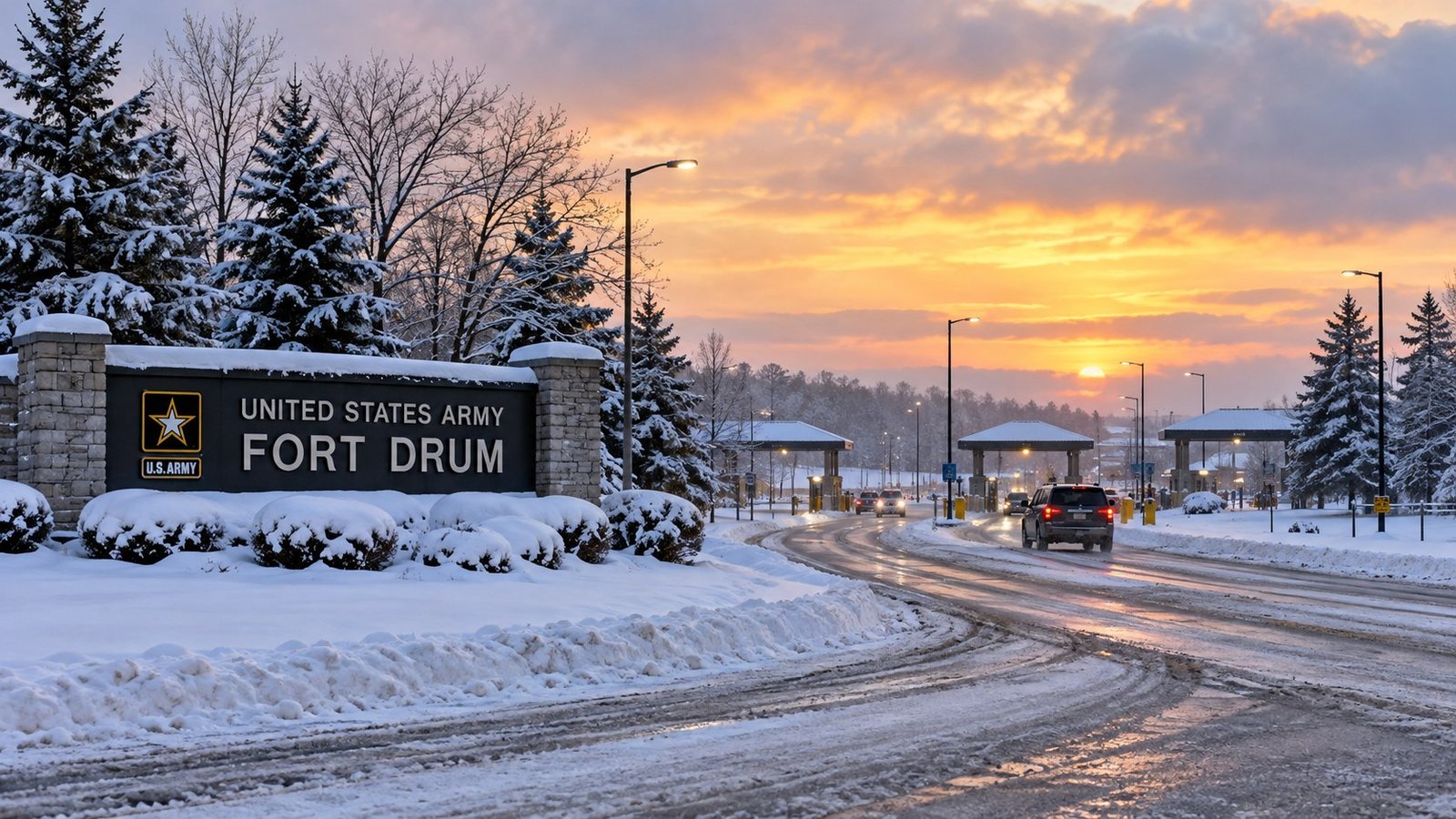
How Fort Drum makes the weather call
Snow decisions at Fort Drum are made overnight, not at the last minute. The Mountain Operations Center analyzes conditions — roads and parking lots, the weather outlook, airfield operations, and feedback from plow crews and emergency responders — and briefs the garrison commander, who makes the call, weighing road safety, the potential for worsening weather, and whether plow crews can stay ahead of the storm.
If the decision is a delay or a cancelled duty day, key personnel have it by about 3:25 a.m., and it goes out publicly through ALERT!, the website, Facebook, and local news. If conditions improve, a delay can expire at 6:15 a.m.; if a second decision is needed, the commander gets a fresh assessment by 7 a.m. For an early release, Fort Drum aims to get the word out by 11:30 a.m., so people are not sent home into worsening weather after lunch.
Where to check the status before you leave home:
- Fort Drum Post Status page — the weather outlook plus current road conditions for the cantonment and range areas, each with the time posted. Bookmark this page.
- ALERT! — the post’s emergency messaging system, its authoritative source for emergency messaging. Soldiers and civilian employees enroll from a government computer (link on the Post Status page); family members’ contact information can be added so spouses get the messages too.
- My Army Post App (MAPA) — carries post status and weather information.
- Fort Drum Information Hotline, (315) 772-DRUM (3786) — Option 1 for delays and closures, Option 2 for road conditions.
- Fort Drum’s Facebook page and local news media carry the same announcements.
The three orders: Delayed Reporting, Do Not Report, Early Release
When inclement weather affects Fort Drum, the garrison commander issues one of three orders. In all three, one rule never changes: mission-essential, emergency-essential, and weather-essential personnel — including those identified for snow removal — report as scheduled or remain on duty. And your chain of command can always direct otherwise, overriding the general announcement.
Delayed Reporting
Only essential personnel report as scheduled. Everyone else reports late: non-essential military personnel report at 9:30 a.m., non-essential civilian personnel at 9 a.m.
For families, the key detail is childcare: Child and Youth Services (the child development centers and School Age Center) opens at 8:30 a.m., so plan the morning accordingly. Guthrie Ambulatory Health Care Clinic, the troop clinics, and the dental clinics open at 9 a.m.; earlier appointments should be rescheduled. AAFES locations open as scheduled; other support services stay closed until 9 a.m.
Do Not Report
This is the order newcomers most often misread as “Fort Drum is closed.” It is not a closure. Essential personnel still report; everyone else, unless their chain of command notifies them otherwise, should not report.
What actually closes on a Do Not Report day: Child and Youth Services, the Guthrie clinic and all troop and dental clinics, all gyms, and the Commissary. Clark Hall agencies close and their appointments are cancelled. New arrivals still have a door open: the Mountain Reception Company (Bldg. 4412) stays open for in-processing Soldiers. AAFES businesses may or may not open; call the specific business to check.
Early Release
Essential personnel remain on duty; everyone else is released at a designated time announced with the order. The family-relevant math: Child and Youth Services, the gyms, and the Commissary all close one hour after the release time — plan the pickup window accordingly.
So — does Fort Drum close for snow?
Almost never in the way a civilian employer closes. No order empties the post: even on a Do Not Report day, essential personnel are working, plows are running, gates are staffed, and new arrivals are being received. What closes are individual facilities and services, on the schedules above.
The takeaway: never assume. A rumor, a nearby school closing, or a quiet parking lot is not the announcement — the Post Status page, ALERT!, and the hotline are.
Road conditions: Green, Amber, Red, Black
Separate from the reporting orders, Fort Drum rates road conditions in four colors, set out in the Road Condition Reference Chart (Appendix C of Fort Drum Regulation 525-27). The Post Status page posts two ratings — cantonment and range — because training-area conditions can be worse than around housing and headquarters. The ratings are mandatory for government vehicle operators; Fort Drum recommends private drivers use the same guidance.
- GREEN — Normal driving conditions. Roads are clear and dry; no special equipment required.
- AMBER — Cautionary conditions. Roads are wet, or have snow or icy areas. Slow down, add following distance, take extra care.
- RED — Hazardous conditions. Roads are covered with ice or hardpacked snow, and heavy precipitation or high winds limit visibility. No unnecessary travel; tire chains are recommended for vehicles authorized to use them, and government dispatches need an O-5 commander’s approval.
- BLACK — Extremely dangerous, life-threatening conditions. Roads are covered with hardpacked snow or ice and may be unplowed, with heavy snowfall or high winds causing zero visibility. All vehicle traffic is suspended except police, fire, medical, snow removal, service, and national-defense operations.
Read the colors as a personal gauge, even in your own car: Amber means budget real extra time; Red means ask whether the trip needs to happen; Black means stay off the roads.
The commute: lake effect does not respect the gate
Most Fort Drum families live off post — in Watertown, Evans Mills, Philadelphia, Carthage, and the villages in between — so the morning drive crosses two weather systems: the post’s, and Lake Ontario’s.
Lake effect snow falls in bands. A band sitting over Interstate 81 south of Watertown can produce whiteout conditions while Fort Drum, a few miles northeast, sees only flurries — and the reverse happens just as often. National Weather Service statements for this area routinely single out the I-81 corridor through Jefferson County for exactly this. Route 11, the main surface route through Philadelphia and Evans Mills, collects the same bands at lower speeds.
Two habits cover most of it. First, check 511NY (511ny.org) for off-post road conditions before you leave, every time — Fort Drum’s own guidance to commuters says the same. Second, treat the post’s road-condition color and the 511NY picture as two halves of one commute; either can be the bad half on a given morning. For driving technique — following distance, whiteouts, what to do when a band closes over the highway — see our Winter Driving in Northern New York guide.
Families: school closings are a separate call
A Fort Drum delay or Do Not Report order says nothing about your children’s school, and a school closing says nothing about the post — independent decisions, made by different organizations on different timelines.
On-post childcare follows the post’s orders, as detailed above. Off post, each district makes its own call and announces it through its own channels. Indian River Central School District in Philadelphia, where many Fort Drum families live, sends delay and closing alerts through ParentSquare by voice, email, and text, plus its website, social media, and local radio and television; other districts around post — Carthage, Watertown, and the rest — run their own systems.
Set up both sides before the first storm: enroll in ALERT! for the post’s word, and make sure your district has your current phone and email. On the mornings when the post delays but school does not — and they will happen — you will be glad the plan was made in advance.
Car and gear: the short version
This guide is about the post’s systems; the hardware side is covered in depth elsewhere on NNY Info:
- The Garrison Safety Office’s winter guidance starts with “see and be seen”: clear all snow and ice from windows, roof, and lights before driving, keep tires properly inflated, use freeze-rated wiper fluid, and double or triple following distance on slick roads.
- For tires — the biggest equipment decision here — see Snow Tires in Northern New York: what to buy, what it costs, and when the studded-tire window runs.
- For the full preparation picture — car kit, home readiness, cold-weather basics — see the Winter Survival Guide.
Frequently asked questions
Does Fort Drum close for snow?
Not as a whole. The garrison commander issues one of three orders — Delayed Reporting, Do Not Report, or Early Release — and essential personnel report under all of them. What closes are individual facilities: on a Do Not Report day, Child and Youth Services, the clinics, the gyms, and the Commissary close, while Mountain Reception stays open for new arrivals.
Where do I check Fort Drum’s status on a snow morning?
Start with the Fort Drum Post Status page, which posts the weather outlook and current road conditions, or call the Fort Drum Information Hotline at (315) 772-DRUM (3786) — Option 1 for delays and closures, Option 2 for road conditions. ALERT!, the My Army Post App, and Fort Drum’s Facebook page carry the same announcements.
What do Fort Drum’s road condition colors mean?
Green is normal driving. Amber is cautionary — wet, snowy, or icy roads. Red is hazardous — ice or hardpacked snow with limited visibility, and no unnecessary travel. Black is extremely dangerous — zero visibility possible, with vehicle traffic suspended except emergency, medical, and snow-removal vehicles. The ratings bind government vehicles; Fort Drum recommends private drivers follow them too.
If Fort Drum delays reporting, is my child’s school delayed too?
Not necessarily. Districts around post decide independently and announce through their own channels — Indian River, for example, alerts parents through ParentSquare. On-post Child and Youth Services does follow the post’s orders: 8:30 a.m. opening on delayed-reporting days, closed on Do Not Report days.
Keep reading
- Fort Drum hub — all of NNY Info’s Fort Drum guides in one place
- Winter Driving in Northern New York
- Winter Survival Guide
- Snow Tires in Northern New York
Sources: Fort Drum Post Status | Weather | Alert Messaging · Fort Drum Weather Messages · Fort Drum Road Condition Ratings Chart (Appendix C, Fort Drum Regulation 525-27), home.army.mil/drum · “Fort Drum’s winter weather call policy balances mission and safety,” army.mil · Indian River Central School District — Emergency Closing Information
Facts verified October 24, 2026.