
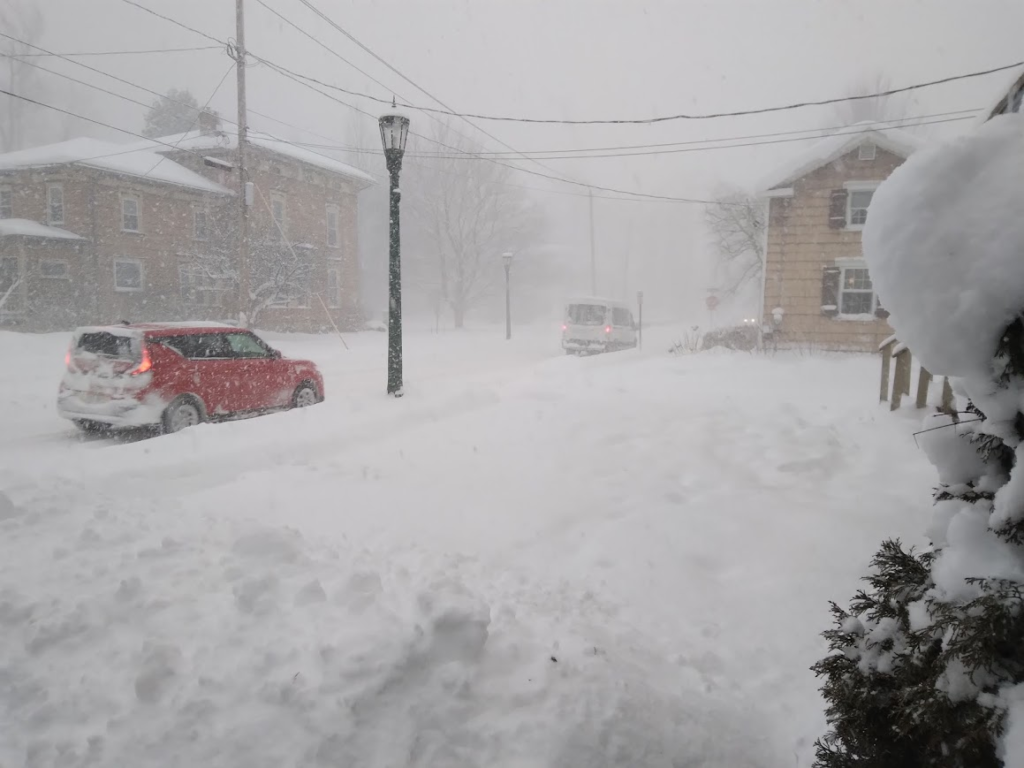
Winter driving in Northern New York — Jefferson, Lewis & St. Lawrence Counties — isn’t just “driving in snow.” It’s lake-effect bands that drop visibility to zero in a quarter mile, rural roads that don’t see a plow for hours, and commutes where the weather at your house has nothing to do with the weather ten miles down the road. This guide covers what to do before winter, the New York laws that actually apply, how to drive when it gets bad, and what to do when it gets worse than that.
On this page
What makes winter driving different here
Most winter driving advice is written for places that get a few storms a year. The North Country gets a few storms a week. The Tug Hill Plateau — just south of the tri-county line, but its weather doesn’t respect county borders — averages more than 200 inches of snow a year, making it one of the snowiest places in the eastern U.S. (Montague, in Lewis County, holds the state record: 77 inches in 24 hours, January 1997.)
The signature hazard is the lake-effect band: a narrow wall of snow, sometimes only a few miles wide, that can turn a clear highway into a whiteout between one exit and the next. The I-81 corridor between Watertown and Syracuse is famous for it — drivers cruise along in sunshine, hit the band near Adams or Parish, and suddenly can’t see the hood of their own car. Fort Drum commuters know the drill: check the sky to the west before you leave, not just the forecast for your town.
Rural two-laners (Route 11, Route 12, Route 3, Route 26) are the other reality. They’re the last roads plowed and the first to ice over, with no streetlights, no guardrails in long stretches, and ditches that swallow cars whole.
Before winter: get the car ready
Do this in October, not during the first storm.
Tires matter more than drivetrain. Four-wheel drive helps you go; it does nothing to help you stop. Good tires are the single biggest safety upgrade you can make.
- Snow tires (unstudded) are the right call for most North Country drivers. The softer rubber stays grippy below freezing, and the tread is designed to bite into snow and slush.
- Studded tires are legal in New York from October 16 through April 30 — outside those dates they’re a ticket. They’re the best option for glare ice, but they’re noisier, wear pavement, and most drivers don’t need them.
- Check tread depth: New York’s legal minimum is 2/32 of an inch, but that’s a legal minimum, not a winter minimum. If you’re anywhere near it, replace before December.
Battery, wipers, fluids. Cold kills weak batteries — if yours is more than four years old, have it tested. Put on winter wiper blades, top off the washer fluid with the de-icing kind (the blue summer stuff freezes on contact), and make sure the defroster actually works before you need it.
Build a winter emergency kit and leave it in the car all season: blanket or sleeping bag, flashlight with spare batteries, phone charger, a few energy bars, water, a small shovel, sand or cat litter for traction, jumper cables, and a bright cloth to tie to the antenna if you’re stuck. (The full household version lives in the Winter Survival Guide.)
Keep the tank at least half full. If you slide off Route 26 at 10 p.m. in a lake-effect band, the heater is your lifeline, and the heater needs gas.
The New York laws that actually apply
- Wipers on, headlights on. New York’s Vehicle and Traffic Law (§375(2)(a)) requires your headlights whenever your wipers are running — day or night, rain or snow. Daytime running lights don’t count; they usually don’t light your taillights, which is the part other drivers need to see. Don’t trust the automatic setting in daylight storms — flip them on manually.
- Studded tire dates (above): October 16 to April 30. Run them in May and you’re asking for a fine.
- Clearing snow off your car: no law, do it anyway. New York has no statute requiring you to clear snow off the roof and hood — bills have been introduced and never passed. But a sheet of ice launching off your roof at 55 mph on I-81 is a hazard to everyone behind you, and troopers can cite you for other violations if it causes a problem. Two minutes with a brush beats a bad outcome.
- Chains and traction devices can be required during severe storms on certain roads — when that happens, 511NY and NYSDOT alerts will say so. Carry a set if you regularly drive the Tug Hill corridor; otherwise, know that the requirement exists.
How to drive when it’s bad
The fundamentals, North Country edition:
- Slow down and add space. Double your normal following distance at minimum; triple it on ice. Everything takes longer — braking, turning, reacting.
- Brake and turn gently, separately. Hard braking or sharp turning on slick roads; never both at once if you can help it. If you have ABS, press and hold — don’t pump. (If you don’t have ABS, then pump.)
- Don’t use cruise control on snow, ice, or even wet roads. You want your foot in direct contact with what the car is doing.
- Bridges and overpasses freeze first. The Black River bridges, the I-81 overpasses, any elevated stretch — treat them as ice until proven otherwise, even when the rest of the road looks fine.
- In a skid: look where you want to go, steer gently in that direction, ease off the gas. Don’t slam the brakes and don’t overcorrect — the second skid is the one that puts you in the ditch.
- Watch for the plows, don’t crowd them. Give plow trucks a wide berth — their spray alone can white you out for a few seconds, and the windrow they push up can grab a tire and yank you sideways. Never pass on the right.
Lake-effect whiteouts: the North Country special
A whiteout isn’t just heavy snow — it’s the sudden loss of all visual reference. No lane lines, no road edge, no horizon. Lake-effect bands produce them routinely along the I-81 corridor and across the Tug Hill approaches.
If you’re driving and the world goes white:
- Slow down immediately, smoothly. No sudden braking — the car behind you can’t see you either.
- Turn on your hazard lights. Be visible.
- Get off the road completely — a parking lot, a side road, a rest area. Do not stop in the travel lane or on the shoulder; that’s where the next blind driver will hit you.
- If you can’t get off the road, stay in the car, hazards on, seatbelt on, and wait for the band to pass. Bands move — most pass in 20–40 minutes.
The real move is prevention: before a winter drive, check conditions along your route, not just your town. 511NY shows live road conditions, plow activity, and traffic cameras statewide — including the I-81 corridor cameras, which let you literally look at the road ahead before you leave.
When not to drive at all
Counties and the state can issue travel advisories (avoid unnecessary travel) and travel bans (stay off the roads — enforceable, with fines). Jefferson, Lewis, and St. Lawrence counties have all done it during major lake-effect events. A ban means emergency crews can’t reach you either — respect it.
Check before you go:
- 511NY (511ny.org) — road conditions, closures, cameras
- Your county’s emergency management alerts and the National Weather Service (the Buffalo office covers the region)
- Local news outlets for ban announcements — this is also where the Northern New York News stream comes in handy during storms
If the forecast says a band is setting up over your route during your commute window, the correct move is leaving early, leaving late, or not leaving. No meeting is worth a whiteout.
If you slide off or get stuck
- Stay with the car. It’s shelter, it’s visible, and it’s where rescuers look. Walking for help in a whiteout is how people die.
- Call for help, then conserve: run the engine in bursts (10–15 minutes per hour) for heat, crack a window to prevent carbon monoxide buildup, and make sure the tailpipe is clear of snow.
- Make yourself visible: hazards on, dome light on at night, bright cloth on the antenna.
- Use the sand or cat litter under the drive wheels for traction. Rock gently between drive and reverse — spinning the tires just digs you deeper.
Frequently asked questions
Are studded snow tires legal in New York?
Yes — from October 16 through April 30 each year (Vehicle and Traffic Law §375(35-a)). Outside those dates they’re a ticket. For most North Country drivers, unstudded winter tires are the better everyday choice: studs shine on glare ice but are noisier and chew up pavement.
Do I have to clear the snow off my car in New York?
New York has no specific law requiring it — bills have been introduced but never passed. Clear it anyway: ice flying off your roof at highway speed endangers everyone behind you, and troopers can cite you under other unsafe-vehicle provisions if it causes a problem.
Go deeper: Winter Survival Guide: How to Prepare Your Car and Home for North Country Snow · Snow Tires in Northern New York · October Winter-Prep Checklist · Thousand Islands Bridge Tolls & Border Crossing Guide